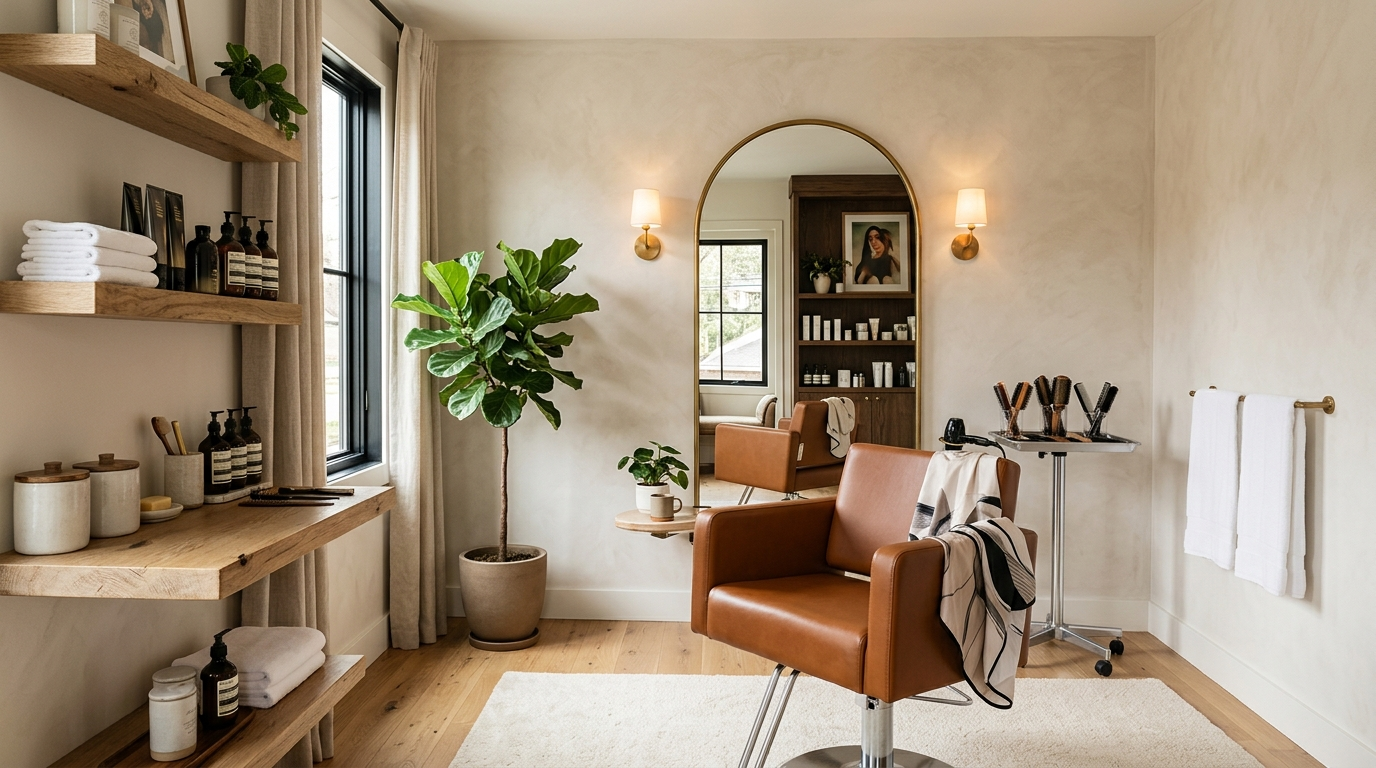
Your Suite Sits Empty More Than It Works
Let me ask you something about your suite. How many hours a week is somebody actually in it? A typical beauty pro works 25 to 35 hours a week. A week holds 168 hours. So your suite is sitting empty 133 to 143 hours a week, every week. That is a lot of paid-for square footage doing absolutely nothing.
Here is how to think about those empty hours: every one of them is money you are not collecting. If your suite could earn $15 an hour during that dead time and you filled just 20 of those hours, that is $300 a week. Over a year, that is $15,600 from a space that was already yours, already paid for, just sitting idle.
Platforms like Cabas turn that idle time into income by connecting your open hours with licensed pros who need a private place to work. You set the price. You set the availability. A smart lock handles the door. The platform handles booking, payment, and payouts. Once you are set up, your day-to-day involvement is close to nothing. That is what makes it passive.
Fill just 20 empty hours a week at $15 and your idle suite makes $15,600 a year.
How It Works for Owners
The flow is simple, and most of it runs itself.
List your suite on Cabas. Upload real, high-quality photos. Describe the amenities, equipment, and location. Set your hourly and daily rates. Then set your availability calendar and block the hours you use the suite yourself.
Install a smart lock. This is the piece that makes it truly hands-off. A compatible lock (August, Yale Assure, or Schlage Encode) connects through Seam, the access technology Cabas uses. When a pro books, Cabas generates a unique door code that turns on right before the booking and expires when it ends. No physical keys, no meeting anyone at the door, no copies floating around your building.
A pro books, gets their code by text, shows up, works, and leaves. Cabas collects the payment and deposits your earnings straight to your bank within 2 business days of the booking finishing.
Your job after setup is small: keep the suite clean between bookings, keep the lock charged and on Wi-Fi, and answer booking requests or messages within 24 hours. Everything else runs automatically.
What You Can Realistically Earn
Your income comes down to three things: your city, your hourly rate, and your occupancy (how many of your open hours actually get booked). Let me show you real ranges so you can find yourself.
Smaller markets like Montgomery, Birmingham, or Louisville run $8 to $15 an hour. Fill 15 to 20 hours a week at $12 and your gross is $180 to $240 a week. After the 12 percent platform fee, you net $158 to $211 a week, or $8,200 to $11,000 a year.
Mid-size markets like Houston, Atlanta, Dallas, Charlotte, or Nashville run $15 to $25. Fill 25 to 30 hours at $20 and your gross is $500 to $600 a week. After the fee, you net $440 to $528 a week, or $22,880 to $27,456 a year.
Premium markets like New York, Los Angeles, or Miami run $30 to $60. Fill 20 to 30 hours at $40 and your gross is $800 to $1,200 a week. After the fee, you net $704 to $1,056 a week, or $36,608 to $54,912 a year.
Own more than one suite and it multiplies. Three suites in a mid-size market at $20 an hour, each filling 25 hours a week, brings in roughly $68,640 a year after fees.
And remember, all of this is on top of whatever you earn using the suite for your own clients. This is not instead of your income. It is on top of it.
How to Price Your Suite
Start by studying your local market. Look at what traditional suites lease for weekly and convert it to an hourly number. A suite that leases at $400 a week works out to about $57 an hour across a 7-hour, 7-day week. Your hourly rate should sit well under that, because hourly renters are committing to less time and less certainty, and they are paying for the flexibility.
A solid starting point is 30 to 50 percent of that lease-equivalent hourly rate. If the equivalent is $57 an hour, price yours at $17 to $28.
Think about tiered pricing too. Peak hours (Tuesday through Saturday, 10 to 6) hold your standard rate. Off-peak hours (early mornings, late evenings, Sundays, Mondays) can go 15 to 25 percent cheaper to fill time that would otherwise be dead.
Daily rates should come in under the straight hourly math. If you charge $20 an hour, a full 8-hour day would be $160, so offer $125 to $140 to reward longer bookings and lock in the whole day.
And here is the move that gets you going: start a touch below what you think the market will bear. It is far easier to raise prices once you have 10-plus good reviews than to land your very first booking at premium rates with no track record yet. Get the reviews, then raise.
How to Keep Your Suite Booked
The gap between earning $500 a month and $2,000 a month from your suite is almost always occupancy, not price. So let me tell you exactly how to stay booked.
Photos decide bookings, full stop. Shoot high-quality images with good light. Show every angle. Get close-ups of the equipment, the mirror, the outlets, the styling chair, the shampoo bowl if you have one, any special feature. A listing with 8 to 12 clear photos gets far more bookings than one with 3 dim ones. This is the single biggest lever you control.
Describe your amenities completely and honestly. Every piece of equipment, every feature, every convenience. Pros pick suites based on whether the space has what their specific service needs, so leaving something out costs you a booking.
Answer requests and messages within 24 hours. Slow replies lose bookings to the suite down the road. And if you can turn on instant booking (auto-approve), do it, it removes the wait entirely and lifts your booking rate a lot.
Keep your calendar honest. Block the hours you use yourself. Nothing torches your reputation faster than a double booking.
And chase repeat bookings, because that is where passive really kicks in. A pro who has a great experience comes back every week. Keep the space clean, the equipment working, the lock reliable, and you build a base of regulars who fill your calendar for you.
What You Need to Get Started
If you already have a suite, getting going costs almost nothing.
A smart lock runs $150 to $250, one time. The August Wi-Fi Smart Lock ($150 plus $50 for the keypad), Yale Assure Lock 2 ($150 to $200), and Schlage Encode Plus ($200 to $250) all work with the Seam platform Cabas uses.
Insurance is recommended. Check with your current property and liability insurer that short-term professional use by other licensed pros is covered. If it is not, adding that coverage usually runs $15 to $50 a month.
Cleaning supplies to keep the space fresh between bookings run $20 to $50 a month.
That is the whole list. No franchise fees, no platform subscription, no long-term contract. Cabas takes a 12 percent commission on each completed booking, which means you only pay when you actually earn. You can be listed and taking bookings within a day of installing your lock.
Tax Considerations
Rental income from your suite is taxable, so let me give you the basics to keep you out of trouble.
Cabas runs payments through Stripe. Earn $600 or more on the platform in a calendar year and Stripe issues you an IRS Form 1099-K reporting your gross rental income. Expect it and plan for it.
You can deduct expenses tied to the rental activity: the smart lock, cleaning supplies, maintenance and repairs, the insurance premiums for the rental use, and a proportional share of your lease or mortgage if you own the space. Those deductions are real money back, so track them.
Self-employment tax may apply if this is your primary business. If it is supplemental income alongside your own beauty services, the treatment depends on how your overall business is structured.
Keep every receipt tied to the suite, and track this income and these expenses separately from your personal finances. And talk to a tax professional about your specific situation, that consultation is itself a deductible business expense, so there is no reason to skip it.