What an Inspection Actually Is
A state board inspector walks in without an appointment, usually during business hours, usually once every year or two, sometimes because a client complained. The visit takes fifteen to forty minutes. The inspector is not there to watch you cut. The inspector is there to check that a short list of things is where it should be, labeled the way it should be, and current.
That is the good news: the list is short, it is public, and it is the same list at every visit. Every state posts its rules and most post the inspection checklist itself. Pros get written up not because the rules are hard but because a jar was unlabeled on a Tuesday.
Fines in most states run from a warning to a few hundred dollars per violation, and repeated or serious ones can suspend a license. The suite owner can be cited as well as the pro, which is why good owners care about this as much as you do.
The list is short, it is public, and it is the same at every visit. Pros get written up because a jar was unlabeled on a Tuesday.
The Six Things Every Inspector Looks For
One: your license, posted where clients can see it, current, with your photo if your state requires it. The most common write-up in the country is a license in a drawer.
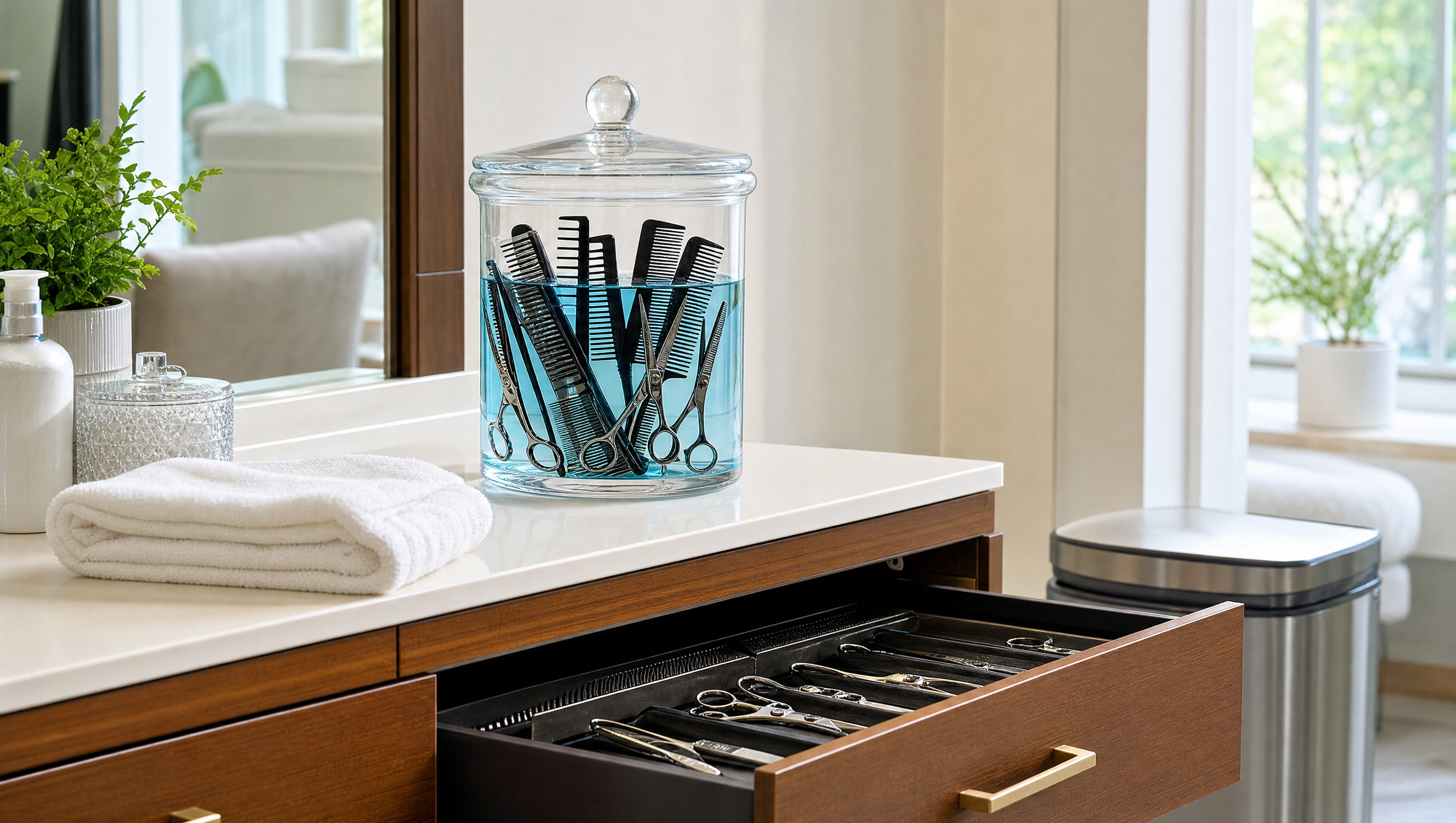
Two: disinfectant, mixed to the label, in a covered container, labeled with the product name, and changed as often as the label says. Inspectors read the label on the bottle and then look at what is in the jar. Water with a tint is the second most common write-up.
Three: clean versus dirty. Clean tools in a closed, labeled drawer or container. Used tools in a separate, labeled container. Never mixed, never open on the counter after use. An inspector will pick up a comb on your station and ask whether it has been used today.
Four: single-use items used once. Neck strips, wax sticks (no double-dipping), nail files and buffers unless your state allows disinfecting them, razor blades, and anything that cannot be immersed in disinfectant. A used file in a drawer is a citation.
Five: the room itself. Floors swept between clients, hair not accumulated, a lidded trash can, a working sink with soap and towels, no food where you work, no pets. Towels and capes laundered between clients and stored covered.
Six: paperwork. Your establishment license if your suite needs one, your MSDS or SDS sheets for chemicals within reach, your bloodborne pathogen or sanitation certificate if your state requires one, and in some states a written cleaning log.
What Changes From State to State
The six above are close to universal. What varies is the detail, and the detail is what gets people.
Whether files and buffers can be disinfected and reused or must be thrown away after one client. Texas and Georgia allow disinfection of non-porous tools and require single use for porous ones; check your state's list of what counts as porous.
Whether a wet disinfectant is enough or your state also requires a dry sanitizer cabinet or UV unit for storage. Some do. Some inspectors ask about it even where they do not.
Whether the suite itself needs its own establishment license separate from your personal license. In many states a private suite that a pro rents does; in some a shared building holds one license for all rooms. Ask your owner which it is and where the certificate is posted.
How long disinfectant contact time must be. The label on the product sets it (often ten minutes), and the inspector will ask you what it is. Know the number.
Whether mobile pros need a separate mobile license or a vehicle inspection. Several states require it and most mobile pros do not know.
Your state board's website has the rules and often the inspector's own checklist. Read the checklist once a year. It changes.
The Ten-Minute Routine That Keeps You Always Ready
Inspections are unannounced, so the only strategy that works is a room that is always ready. This is the routine the pros who never get written up actually run.
Between every client, three minutes: used tools into the dirty container, single-use items into the lidded bin, station wiped with disinfectant, floor swept, cape and towels into the laundry bag, fresh ones out.
Start of every day, five minutes: mix or check the disinfectant jar, confirm the label is on it and the date is written, restock single-use items, put the clean-tools drawer in order, empty the bin, check the license on the wall and the SDS binder on the shelf.
End of every week, ten minutes: dump and remix the disinfectant regardless, wipe every surface including the ones clients do not see, launder everything, check the first-aid kit, read your cleaning log if your state wants one and write the entry.
Do those three and an inspector can walk in at any minute of any day and find nothing. That is the entire goal. Not a clean-up when you hear the door; a room that never needs one.
When the Inspector Walks In
Be polite and unbothered. Say hello, keep working if you have a client in the chair, and let them look. You are allowed to ask for identification. You are not required to stop mid-service.
Answer questions with the number, not a story. "Contact time is ten minutes. Changed daily, dated on the lid." Inspectors write up hedging as often as they write up violations, because hedging means you do not know.
If they find something, fix it in front of them if you can. A missing label goes on the jar while they watch. Most inspectors note the fix and move on; the ones who still cite it are citing the habit, not the jar.
If you get a citation, read it, correct it, and keep the proof. Most states give you a window to fix and reply. Ignoring it is how a warning becomes a fine and a fine becomes a hearing.
Why This Is Worth More Than the Fine
Clients notice. Not the checklist, but the jar with a label, the drawer that closes, the floor with no hair on it. A visibly clean room is the fastest trust you can build with a stranger, and it is the thing she tells her friend about after the style.
Owners notice too. A pro who keeps the room inspection-ready is the pro an owner wants back on the calendar, and on the platforms where owners rate pros, Cabas among them, a clean checkout is part of what makes a pro's next booking easy.
And you notice. A room that is always ready is a room you are never embarrassed by, at 9 a.m. with an inspector or at 7 p.m. with a client who has been in your chair for six years. Ten minutes a day buys all of that. Pay it.